REIMAGINING FAMILIES & DISCIPLESHIP: FORUM UPDATE
[18 Minute Read]
Dear fellow pursuers of the purposes of God in the world,
Grace and peace to you in the name of the Lord Jesus Christ.

English

Watch
Where do tomorrow’s disciple-makers come from? They do not suddenly appear in adulthood, one speaker reminded us; faith and a desire to serve usually begin in childhood, and very often at home. That conviction ran through today’s WEA Mission Commission (MC) forum, “Reimagining Families & Discipleship for Missions”, which brought together church and missions leaders from many time zones—from the afternoon in Europe to India in the evening and New Zealand and Fiji in the middle of the night.
This was the MC’s third forum this year. Each has taken up an issue raised as critical at the WEA General Assembly in Seoul last year. Host Dr Ruth Wall, MC Co-Leader, described today’s aim as giving these concerns more time for conversation, learning, and discussion—not to exhaust the topic, but to put it firmly on the map. Four presentations were followed by short breakout conversations.
1. The family as a neglected mission field
Rev. Barnabas Moon, a member of the MC Executive, opened with a case study from churches across Asia. A Korean joining from a diaspora consultation in Fiji, he drew on reflections from two Asian Evangelical Alliance leaders: Gwen de Rosario Serra, director of the AEA Family and Children Commission, who serves in Singapore and Cambodia, and Grace Hee of Malaysia, director of the AEA Women’s Commission.
Watch Barnabas Moon’s presentation on YouTube.
His central point was that the family can become a neglected mission field. We tend to picture mission as distant countries and unreached peoples, he said, yet “the people living under our own roof are also entrusted to our spiritual care.” A church-centred approach can unintentionally weaken families’ own sense of spiritual responsibility, so that children attend church regularly but meet little discipleship at home.
He was equally clear that many families face conflict, separation, economic hardship, or emotional pain, and that family discipleship “must never become simply another expectation placed upon struggling parents.” It needs “both responsibility and grace.” With so many Asian families now living across borders through migration, study, work and marriage, he urged churches to accompany diaspora and vulnerable families, and to see them not only as recipients of care but as participants in God’s purposes through hospitality and friendship. His practical steps were simple: listen, read Scripture, and pray together, and live the gospel in everyday life. He closed with a line many will remember: “Discipleship begins at home, grows through the church, and extends to the nations.”
2. A biblical framework: God’s macro plan through a micro plan
Dr P. C. Matthew, Global Director of the WEA Family Challenge and principal of the Family Research and Training Institute in Bangalore, offered a biblical framework under the question “Why family discipleship?” When he had raised the family as an issue in MC circles in the past it was not familiar terrain but welcomed the chance to address it now.
Watch P. C. Matthew’s presentation on YouTube.
He argued that the family crisis is not only social, psychological, or economic, but theological. From Genesis he traced humanity created “in the image of God for the mission of God”—the imago Dei for the missio Dei—and read “be fruitful and multiply” as a multigenerational vision of faith passed on. Genesis 18:19, where Abraham is chosen to direct his children and household in the way of the Lord, showed, he said, that “God’s macro plan is to be fulfilled by following his micro plan for every family.”
From Deuteronomy 6, Ephesians, and Matthew 28:18-20, he concluded that parents are “the chief faith shapers and not the church. Church can complement.” A short sermon cannot teach everything Jesus commanded; that happens in homes, with parents, grandparents, and wider family. Finally, from Malachi 4:6 and the ministry of John the Baptist, he presented family discipleship as part of preparing for Christ’s return—hearts of parents and children turned towards each other.
3.Children are part of the church today
Rev Dr Rebecca Goropevsek, co-leader of the WEA Children’s Network, who also serves on the Global Leadership Council of World Without Orphans and works in Christian education, began with a question she hears everywhere: where are the next leaders?
Watch Rebecca Goropevsek’s presentation on YouTube.
At a recent European Evangelical Alliance event, she said, one leader told her there was no one in his country to take over church leadership. Perhaps, she suggested, we are asking it too late, because the next generation of leaders does not suddenly appear; faith usually begins in childhood.
The COVID-19 pandemic exposed how much parents had come to rely on Sunday school and youth groups. Churches have gradually taken over more of the parents’ role, “mostly without meaning to”. Yet “the church cannot replace parents”: faith is formed at the kitchen table, on the way to school, and in how a family handles conflict.
She cited research by One Hope: in Europe, more than half of teenagers surveyed said they turn to their family for guidance on life’s big questions, against about 4% who turn to religious leaders. Two in three parents said they are most responsible for their children’s faith, yet fewer than a third believe they have real influence. Among teens whose parents read the Bible with them, two in three read it weekly themselves, compared with one in ten otherwise. The research points to three ingredients in homes that pass on faith: warm relationships, open conversation (including room for doubt), and authentic everyday example. She also quoted Rick Hiemstra of the Evangelical Fellowship of Canada on the difference warmth makes.
She did not avoid harder realities. Divorce, abuse, and domestic violence are found in Christian homes too, she said, and when the church preaches God’s love but stays silent about what happens behind closed doors, children notice; some quietly walk away.
She noted that Evangelical Alliance leaders in Latin America had this month called on churches to end their silence on abuse. “Protecting children is not a distraction from discipleship, it is part of it.” The church’s task is to equip parents, not to replace them, and to see children as participants, not only recipients. Her question for the groups: what would need to change in our churches and mission organisations for children to be seen and raised as participants in God’s mission today?
4. The family in the workshop
Dr Tania Boisseleau Bertuzzi, who has served COMIBAM (the Ibero-American mission cooperation) in member care for more than fifteen years and represents it in the Global Member Care Network, spoke in Spanish, with live English interpretation by Deinis Mall, who stepped in at short notice. (Quotations below are from the English interpretation.)
Watch Tania Boisseleau Bertuzzi’s English translated presentation on YouTube.
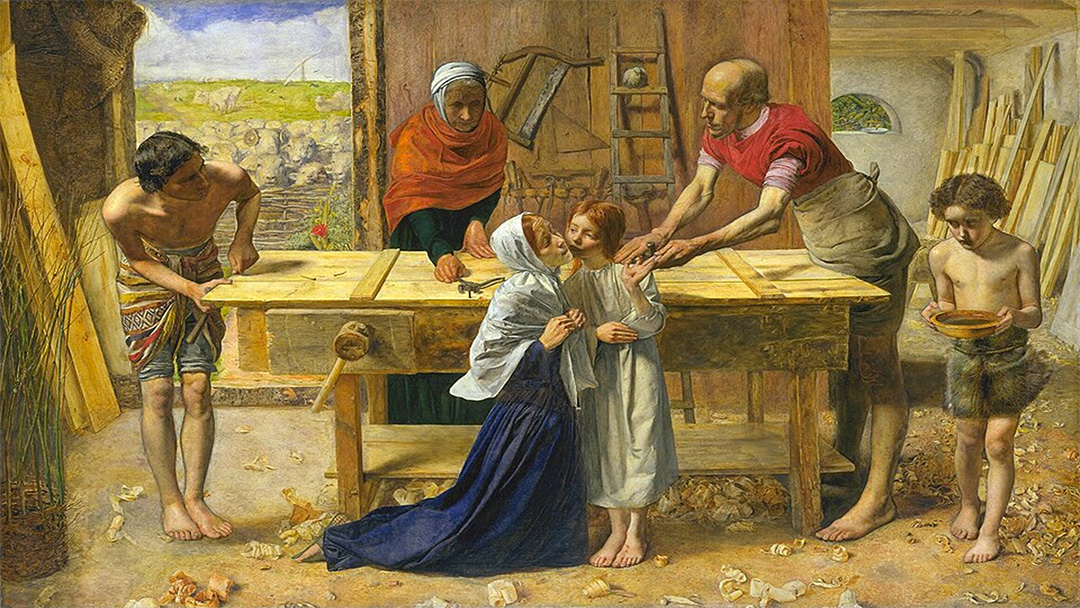
She built her talk around a single nineteenth-century painting by John Everett Millais, Christ in the House of His Parents (pictured below), which shows the young Jesus in Joseph’s workshop with a cut on his hand, comforted by Mary. A family in mission, she said, looks like this: “realistic, messy, vulnerable, in a hostile terrain, truly human”—with Jesus at the centre. She walked through the figures: an attentive father; the young John the Baptist bringing water; a grandmother whose presence speaks of the vital role of grandparents and extended family, who need to understand mission life and how to embrace third culture kids; an apprentice watching closely; and the dove as a sign of dependence on the Holy Spirit. A wide open door shows the outside with many sheep looking in.
She warned against reducing family discipleship to raising obedient children or keeping harmony at home. Lifted towards the vision of Revelation 7, the home becomes a place where “we start to live out eternity”. Sent families need many other families to sustain them—and to support them well. “God did not send his son in spite of a family,” she said, but with one. If the family of Nazareth needed care, how much more do the families serving God’s purposes today? Her closing question: how would our churches change if every family believed it had a strategic role in God’s story to bless all the nations?
5. Breakout group responses
Time for the breakouts was short, around ten minutes. We are questioning the feasibility of breakout group discussion for future forums with a time constraint of only 90 minutes while prioritising providing experienced reflective practitioner content.
Nevertheless, in this session across the groups, participants rejected the idea that children are only the “future church”. One group summed it up with the phrase “no junior Holy Spirit”. They also stressed that empowering children is not about pushing them to act like adults (what one group called “premature adultisation”) but about creating spaces where they can learn, play, and discover their gifts. Small changes of language were seen to matter: speaking of a “foster family” rather than “foster parents” helps children see themselves as part of the ministry. Groups also noted “reverse discipleship”, where children or teenagers challenge, or even lead, their parents in faith.
Participants described a rift between church programmes and home life, with faith treated as a weekly activity. They questioned church approaches aimed at producing “obedient children” rather than discipling parents as people who know how to hear God’s voice themselves. Several stressed that parents and grandparents need to model repentance and humility if generational conflict is to heal. One group described the home as a “workshop” where faith is practised, picking up Dr Boisseleau’s image.
Practical examples surfaced too. From Malaysia came the challenge of “brain drain”, as young people move to cities or overseas and leave ageing congregations. One church had used a string orchestra of amateur musicians to build hospitality and shared interests, drawing whole families into fellowship. Mentoring young families through the pressures of early parenthood was named as a foundation for long-term engagement in mission.
A recurring frustration was a “resource gap”: most materials are designed for church settings, not for daily family life. The most concrete proposal was for churches to use shared material that the whole congregation and its households study at the same time, so that discipleship becomes a common experience.
6. Open questions remain
The forum did not resolve everything, and it would be wrong to pretend it did. Several questions remain open:
- If parents are the primary faith shapers, how do churches equip them without adding to the burden on parents who are struggling, raising children alone, or were never discipled themselves?
Speakers and groups alike named both responsibility and grace, but how to hold the two together in practice remains open. - How can children be genuine participants in God’s purposes without being rushed into adult roles?
- How will churches break their silence on abuse in Christian homes, including leaders’ homes, while keeping children safe?
- Is our definition of missions activity still too narrow if it looks only overseas and overlooks the home?
- What does family discipleship look like for diaspora families, for third culture kids, and for ageing churches losing their young people?
- Who will develop practical, home-based resources, and how can good examples be shared across regions?
Conclusion: Where to next?
Moving forward, some things were agreed or announced. In the recorded groups, participants committed to take the forum’s insights to their own church leadership teams and elders, and to share examples of creative outreach with other leaders. One group said the conversation would continue within the WEA Global Children’s Network, and that a collaborative team on “children and participation” is being planned. Another group said it would review existing resources and might advocate for curricula that treat the home as a primary place of spiritual formation.
The hosts said the presentations were recorded and that forum material would be made available over the coming weeks, with an aim to add subtitles when the video is prepared for YouTube. The speakers agreed that people may contact them to follow up.
Beyond that, the conversation points to possible next steps for the MC and the wider Church. These are suggestions rather than decisions: gathering and sharing home-based discipleship resources from different regions; learning from churches that align preaching, small groups and family devotions around shared material; giving child protection a clear place in discussions of discipleship; and strengthening care for mission families and the extended families and churches that support them. All four speakers, in different words, made the same appeal: equip the home rather than replace it.