REIMAGINING FAMILIES & DISCIPLESHIP: A DISCUSSION FORUM PRIMER
[18 Minute Read]
Dear fellow pursuers of the purposes of God in the world,
Grace and peace to you in the name of the Lord Jesus Christ.

English
At the WEA General Assembly (GA), the plenary conversation “Celebrating the gospel in disciple-making” raised a significant challenge for the global evangelical community. The question was raised, “have our approaches to discipleship become too centred on church programmes while neglecting the family and household as foundational environments for spiritual formation?”
The panel argued that one of the clearest expressions of celebrating the gospel is the faithful fulfilment of Jesus’ call to make disciples. Yet the discussion also suggested that many current models of disciples-making are imbalanced. Churches may invest heavily in programmes, gatherings and institutional structures while giving insufficient attention to what happens in homes from Monday to Saturday.
The conversation therefore called for a reconsideration of how the formation of disciples takes place, who participates in it, and how the church equips people for disciple-making in ordinary life.
This pre-read summarises the key ideas raised during that WEA GA conversation and invites participants in the forthcoming Mission Commission (MC) Forum to reflect on the implications for families, churches, and missions movements around the world.
1. Discipleship must be more than a church programme
A recurring concern throughout the discussion was the difference between attending church and becoming a disciple who makes disciples.
David Kornfield challenged leaders to consider disciple-making across four interconnected levels:
- Personal and small-group disciple-making — Discipleship begins through close relationships in which spiritual formation takes place personally and relationally.
- Healthy disciple-making churches — Personal discipleship needs a church culture in which disciple-making is normal throughout congregational life, rather than being one programme among many.
- Movements of healthy disciple-making churches — Individual churches should connect with one another in wider movements that share resources, encouragement and momentum.
- National movements — National Evangelical Alliances and similar bodies can help catalyse and support disciple-making movements across whole countries.
The challenge was clear: discipleship cannot be reduced to an event, course or ministry department. It needs to shape the whole ecosystem of Christian life, from personal relationships and households through to churches, movements and national networks.
David linked this concern with the phenomenon often described as “dechurching”, drawing attention to large numbers of people leaving churches in different parts of the world. The panel at the WEA GA understood this not simply as a problem of church attendance, but as a deeper discipleship challenge.
2. The family as a primary environment for authentic discipleship
P. C. Matthew brought the conversation directly into the home. He described the family as a primary and particularly authentic place of discipleship because family life exposes the reality of who we are.
Within a household, faith cannot easily remain a public performance. Family members experience one another’s strengths, weaknesses, habits, relationships and responses to everyday pressures.
He described a damaging divide in contemporary Christian life as: “Sundays are sacred, Monday to Saturday is secret.” The concern is that Christian faith can become visible in church settings but disconnected from everyday relationships and behaviour in the home.
The result, according to the discussion, is a crisis of authenticity that can undermine the credibility of Christian witness and contribute to younger generations disengaging from faith.
His central conviction was simple: “only strong families can make strong churches.” This shifts the question from only asking, “how do we build stronger churches?” to also asking, “how do we equip households to become environments in which faith is genuinely lived, shared and passed on?”
3. Rebuilding the family altar
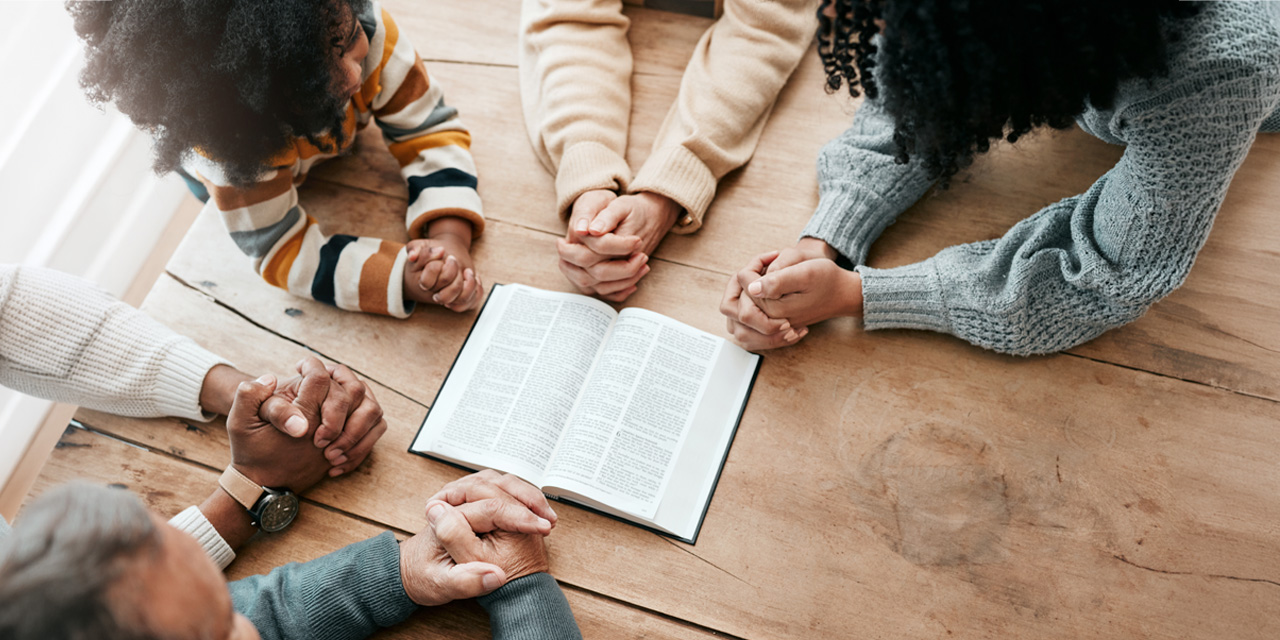
P. C. introduced the Family Revival Movement as a practical response to the challenge. The process begins with something as simple as families praying together.
The first phase encourages families to pray together for seven minutes a day, seven days a week, for seven weeks. After this 49-day period, churches are encouraged to mark the 50th day with celebration
and testimony.
A second phase provides a seven-month process in which pastors teach on seven foundational pillars of a godly family.
The third phase moves the household outward. Families are encouraged not merely to become healthier internally, but to become missional, functioning as a beacon of light within their communities.
The sequence is important. Prayer leads toward formation, and formation leads toward God’s mission.
The family is therefore not presented merely as something the church must protect or minister to. The family itself can become an active context for outreach and disciple-making.
4. The church equips the home rather than replacing it
Another significant contribution focused on the relationship between church and household.
Discipleship fundamentally pivots on relationship. We can see this in Deuteronomy 6, which gives a biblical picture of faith being passed on through everyday family life.
The concern raised was that churches have often unintentionally outsourced the spiritual formation of children and young people to Sunday schools, youth ministries, and other church programmes.
These ministries may be valuable, but they cannot replace the day-to-day formation that happens through relationships in the home. The church’s role, therefore, should include intentionally equipping every member to disciple their household.
The discussion highlighted examples from Korea where churches intentionally aligned sermons, small-group materials and family devotionals around the same theme. This helped move biblical teaching beyond the pulpit and into household conversations.
The result from the Korean example was improved communication between parents and teenagers and the development of stronger biblical foundations among young people.
The point was not that church programmes are unnecessary. Rather, the concern was about imbalance.
An analogy used during the discussion imagined someone hopping on only one leg for a year. One leg would become very strong while the other would weaken. In the same way, the church may have developed strong institutional ministries while the discipleship capacity of the home has become weak.
The challenge for this generation is therefore to strengthen both.
5. Children are not merely recipients of discipleship
The discussion also challenged assumptions about the place of children in the pursuit of God’s purposes.
Alan Charter of the Global Children’s Forum argued that children are too often treated as passive recipients of ministry or as the “church of the future.” Instead, children should be recognised as active participants in God’s mission today.
Alan described children as among the “least deployed kingdom participants.” He emphasised that there is no “junior Holy Spirit” and challenged leaders to recognise children as fellow kingdom builders.
Several examples illustrated this:
- children sharing food with classmates who had none,
- family circumstances unexpectedly opening new opportunities for ministry,
- and a teenager beginning a weekly Bible study with 17 members of his football team.
These stories raise an important question for churches and mission organisations: are children merely being discipled, or are they also being equipped to disciple and participate in mission?
6. From the gathered church to the scattered church
One of the most helpful distinctions in the discussion was between the gathered church and the scattered church.
The gathered church refers to the times when Christians meet together. The scattered church is the church living out its faith in homes, schools, workplaces, neighbourhoods, and everyday relationships. Families live most of their lives within this scattered reality.
This means that mission and discipleship cannot be understood only through what takes place when Christians gather.
The home is one of the most significant places where faith becomes visible, relationships are shaped, beliefs are tested, values are passed on, and everyday mission occurs.
7. From families as consumers to families as disciple-makers
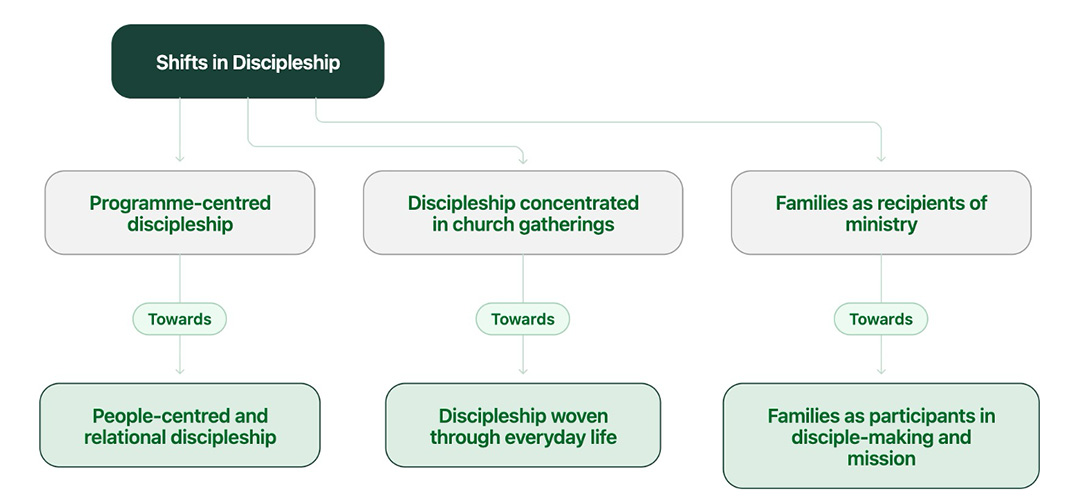
The report summarised the main issue as: the re-centring of disciple-making in the family. Not to simply create additional family ministry programmes, it is a more fundamental shift in perspective.
Instead of viewing families primarily as consumers of church services, the discussion called for churches to empower households as environments from which outreach takes place and in which disciples are formed.
8. Discipleship is transformational, not merely informational
A further principle emerging from the discussion is that discipleship must result in changed lives. The report describes true discipleship as transformational rather than merely informational.
Families provide a particularly significant environment for this because beliefs cannot remain abstract for long. They are expressed through relationships, conflict, forgiveness, prayer, priorities, use of time, generosity, hospitality, parenting, and everyday decisions.
The household therefore becomes one of the places where faith is either made credible or exposed as disconnected from life.
This raises a difficult but important question: what kind of disciples are our present discipleship systems actually producing?
9. The invitation before us
The WEA GA conversation did not conclude by calling for another new programme. Instead, it called leaders back to a foundational principle: discipleship is nurtured through relationships and must become embedded within the ordinary rhythms of life.
Pastors, ministry leaders, and organisational leaders were encouraged to reconsider how resources, training, and attention are allocated.
The call is for a desired shift: moving from seeing families as consumers of church services towards equipping husbands, wives, parents, grandparents, and children to build spiritually vibrant households. To make family life part of the heartbeat of our disciple-making strategy.
Conclusion: Preparing for the forum
As you prepare for the Mission Commission Forum, we invite you to reflect on the following questions…
- Where is discipleship actually happening in your context? Is it primarily located within church programmes, or is it also deeply embedded within homes and everyday relationships?
- What role does the family or household currently play in your understanding of disciple-making and mission?
- How can churches equip households for discipleship without simply creating another church programme for families?
- What prevents parents, grandparents, spouses, and other family members from discipling one another more intentionally?
- How might churches strengthen the connection between what happens in the gathered church and what happens in the home during the rest of the week?
- Are children in your context primarily recipients of ministry, or are they being recognised and equipped as active participants in God’s mission?
- What examples have you seen of family-based discipleship, household mission, or intergenerational disciple-making that others could learn from?
- What would need to change if families were understood not only as recipients of ministry, but as active agents of disciple-making and mission?
The WEA GA conversation did not attempt to provide one universal model for every culture and context. The forthcoming Mission Commission Forum provides an opportunity to continue listening. We want to explore how these questions are being experienced in different parts of the world, what practices are already emerging, where the tensions lie, and what the global church might learn from one another to strengthen our participation in the purposes of God.
The central question remains: how might we reimagine families not simply as people the Church disciples, but as communities in which disciples are formed and from which God’s purposes are pursued in what we understand to be mission activities?
The hope for the upcoming MC Forum is not merely to discuss family ministry. It is to explore what happens when family, discipleship, and mission are once again understood as deeply connected parts of the life and extended outreach of the Church.